Hangzhou · Suzhou · Jiangnan

West Lake mornings, garden afternoons.

Two old cities of the Yangtze delta, ninety minutes apart by rail — the lake at first light, the gardens near closing, tea hills in between.

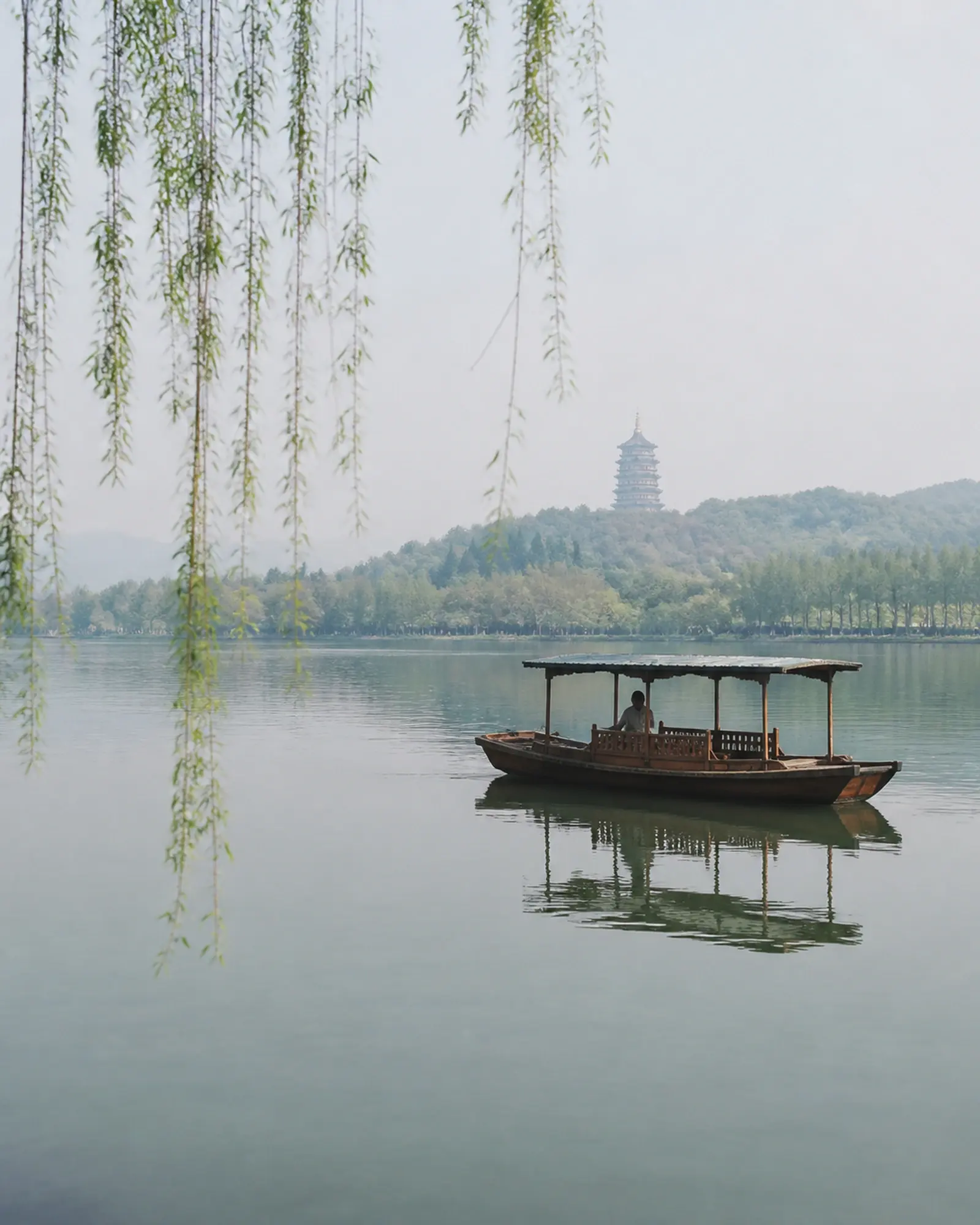
A lone boat on West Lake at dawn, mist softening the hills and a pagoda on the far shoreConcept visual

When to go

The lake keeps a view for every season.

Jiangnan weather is soft-edged — mist, drizzle, sudden clarity. A thousand years of poets insisted every season here has its scene, and they were mostly right. Here is what each window really gives you, crowds included.

  • March – MayThe season the poets promised

    Willows leafing along the causeways, blossom over the water, and the year’s first Longjing tea picked in the hills before the Qingming festival in early April. The honest caveat: all of China knows this too. The Qingming and early-May holidays pack the lakeshore, and mid-April weekdays are the sweet spot.

  • June – AugustLotus, heat and plum rain

    The plum rains drizzle through June into July, then real heat arrives. What you get in exchange: lotus filling the lake’s northern bays, and gardens that were designed for rain — covered walkways, dripping eaves, stone framed by wet green. Early mornings and shaded afternoons make the season workable.

  • September – NovemberThe quiet rival to spring

    From late September, osmanthus blooms and whole districts of Hangzhou smell of apricot and honey; skies clear and the light lengthens. Many of our travellers rate it above spring. One week to avoid: the National Day holiday, 1–7 October, the busiest travel week of the Chinese year.

  • December – FebruaryWinter, softly

    Damp cold, bare willows, and the emptiest causeways of the year. If snow falls, “Lingering Snow on the Broken Bridge” is the most famous single view on the lake — and half the city turns out for it, so we go at dawn. The gardens, near-empty, were composed to frame bare branches as carefully as blossom.

West Lake

The lake is free to all. The morning is the luxury.

Honesty first: West Lake is an open public park at the heart of a city of twelve million, and one of the most visited places in China. By mid-morning the causeways carry a slow river of people, and no private arrangement empties them. What changes everything is the hour — and the shore you choose.

  • On the Su Causeway by first light, when mist and the tai chi practitioners still own the lake
  • A chartered boat out to the islands while the shoreline fills behind you
  • The western shore — Yanggong Causeway, the tea marshes at Maojiabu — quiet even at noon
  • Lingyin Temple and the carved cliff Buddhas of Feilai Feng at opening, ahead of the incense queues
  • The middle of the day spent in the hills, not on the waterfront
  • Back to the water at dusk, as the day-trip coaches pull away

Hangzhou is also our standing answer for travellers with 48 hours to spare around meetings in Shanghai — see howa business & leisure journeyuses it.

The Longjing tea hills

Ten minutes from the lake, a different century.

Behind the western shore the road climbs into terraced tea rows — Longjing village, source of China’s most celebrated green tea, still farmed by the families whose names are on the gates. We walk a ridge path between the terraces, then sit down to a tasting poured by the people who picked it, with the year’s harvest explained leaf by leaf.

If your dates fall in late March or early April, you will see the pre-Qingming harvest at full tilt — pickers on every slope, woks firing in open doorways. It is the one fortnight the village is busy, and the one fortnight it is unmissable. The rest of the year it is simply the calmest afternoon in Hangzhou.

Suzhou’s gardens

Pick two gardens. Not five.

Nine of Suzhou’s classical gardens hold UNESCO listing, and trying to collect them is how a contemplative art form becomes a spreadsheet. Each was built as a scholar’s private world — meant for a few people moving slowly. Two gardens, at the right hours, beat five at the wrong ones.

  • Humble Administrator’s GardenThe grand one

    The largest and most celebrated — pavilions across lotus ponds, borrowed views out to a distant pagoda. Every coach itinerary in Jiangsu knows it, which is the honest problem: it works beautifully at opening time and hardly at all after ten. We book it first thing or not at all.

  • Master of the NetsThe quiet one

    A tenth of the size and, proportion for proportion, perhaps the finest garden in China — a pond, a moon gate, rooms that unfold like a scroll. Toward closing, when the groups have gone, you can have whole courtyards to yourself. This is the one our travellers write to us about afterwards.

  • Lingering GardenThe middle path

    Between the two in size and crowds: covered corridors that turn walking into framing, windows cut so that every step recomposes the view. If you have appetite for a third garden — or want to swap out the grand one entirely — this is where we send you.

  • Pingjiang RoadThe garden’s city

    Not a garden but the world the gardens came from — a canal-side lane of whitewashed houses, stone bridges and slow water, best after dark when lanterns come on and pingtan ballads drift out of the teahouses. The evening walk that stitches a garden day together.

Sample shape · 3–4 days

Two cities, taken at the hours they keep.

Shanghai · Hangzhou ×2 · Suzhou3–4 days

Hangzhou first, so the dawn habit is formed on the lake; Suzhou second, so the gardens get late-afternoon calm and next-morning opening — the two hours they are built for.

  • Day 1 — High-speed rail from Shanghai, about an hour. Settle by the lake, an unhurried dusk walk on the Bai Causeway as the day-trippers leave, dinner over the water. Nothing else scheduled; tomorrow starts early.
  • Day 2 — West Lake at first light: the causeway, then a chartered boat while the mist still holds. Longjing village in the afternoon — a ridge walk through the terraces and a tasting with the family that grew it.
  • Day 3 — Rail to Suzhou, about ninety minutes. The Master of the Nets toward closing time, in the quiet after the groups; Pingjiang Road by lantern light, pingtan drifting from the teahouses.
  • Day 4 — The Humble Administrator’s Garden at opening, ahead of the coaches. Then half an hour by rail to Shanghai for flights home — or the next chapter.

Private guide & driver · rail seats booked · garden & temple tickets · handpicked stays

This is a shape, not a package — there is no fixed itinerary to buy. Three days trims the second garden; five adds a canal town such as Tongli. Every leg of the Shanghai–Hangzhou–Suzhou triangle runs about ninety minutes or less by high-speed rail, which is why this pairs so naturally with Shanghai at either end.

Operated by 成都光大国际旅行社 — licensed since 1987Travel licence L-SC-CJ00008See the paperwork →

Good to know

Questions we hear often.

Hangzhou or Suzhou, if we only have time for one?

Hangzhou, by a nose, for a first journey — West Lake and the tea hills give you landscape, and landscape forgives jet lag. Suzhou is the connoisseur’s answer: its gardens are among the finest built spaces in China, but they reward unhurried attention more than first-day energy. The honest footnote is that the choice is rarely forced — the two cities sit about ninety minutes apart by high-speed rail, and even three days covers both without strain. If your trip truly holds only one, tell us which you love more — water and hills, or architecture and craft — and the answer chooses itself.

When is West Lake at its best?

Late March to mid-April, when the willows leaf and the first Longjing is picked, and October into early November, when osmanthus scents the whole lakeshore. The honest answer runs deeper: the lake has been famous for a thousand years, and its classic Ten Scenes deliberately assign a view to every season — lotus in summer heat, snow on the Broken Bridge in winter. Two windows to avoid are the national holidays in early May and the first week of October, when the causeways fill shoulder to shoulder. Whatever the month, the hour matters more than the date — dawn is the lake’s best season.

Which garden should we choose in Suzhou?

Two, in the right order — not five. The Humble Administrator’s Garden is the largest and most celebrated, and every coach itinerary knows it: it works beautifully at opening and hardly at all after ten. The Master of the Nets is a fraction of the size and, proportion for proportion, perhaps the finest of them all — and it stays calm toward closing, after the groups have moved on. So we book the small one for late afternoon and the grand one for first thing the next morning, and resist the urge to collect the other seven on the UNESCO list.

Day trip from Shanghai, or overnight?

You can day-trip either city — Suzhou is about half an hour from Shanghai by rail, Hangzhou about an hour — and a great many visitors do. That is precisely the problem: a day trip delivers you to the lake and the gardens in their most crowded hours and pulls you out before their best ones. The whole case for these cities is West Lake at first light and a garden near closing time, and neither survives a same-day return ticket. Stay at least one night in each; the trip changes character entirely.

Your brief

Tell us your dates and what slow means to you.

Dates, who’s travelling, and whether the lake, the tea or the gardens comes first — three lines is plenty to start.

No payment, no obligation at this stage. Your details stay between us — see our privacy note.

Start the conversation

Two old cities, one quiet pace.
Planned to the hour.

No pitch, no pressure — just a considered first reply from someone who plans China for a living.

Replies in English · Usually within a few hours, always within 24