Shanghai · Zhujiajiao · Suzhou

The gateway that deserves more than a layover.

Forty-eight to seventy-two hours, spent with intent — the Bund at dawn and again at dusk, the French Concession on foot, and a water town before the flight out.

The Bund promenade at dusk, the lit towers of Pudong across the Huangpu RiverConcept visual

When to go

A city for all seasons — two of them better than the rest.

Shanghai never closes and never quite empties. What changes is the air, the light on the river, and how far you want to walk. Here is the year, plainly.

  • September – NovemberThe clear window

    The typhoon tail passes, the humidity breaks, and the light over the Huangpu turns hard and clean — the best months to be on the water at dusk. One caveat repeats across China: the National Day holiday, 1–7 October, is the busiest travel week of the year, and the Bund is where much of it stands. We plan around it.

  • March – MaySpring, softly

    Mild days, the plane trees coming back into leaf, and the gardens — Yu Garden here, Suzhou’s next door — at their best. Rain passes through, and none of it lasts. April and May are the quiet strong choice for a walking city.

  • June – AugustHot, and we say so

    The plum rains sit over the city from mid-June into July, and August is genuinely hot — mid-thirties with humidity to match. Shanghai answers with interiors: museums, long lunches, cooled cars. We move the walking to early morning, keep midday indoors, and give the river back to you at night.

  • December – FebruaryWinter, quietly

    Grey, damp, and colder than the latitude suggests — and the emptiest the Bund ever gets. A January dawn there can be yours alone. Around Chinese New Year the city half-closes as Shanghai goes home to its families; some of the best small restaurants shut for the week. We will say so if those are your dates.

The Bund, twice

One waterfront, two appointments.

The Bund is the most photographed kilometre in China, and at midday it behaves like it. The answer is not to skip it. The answer is to go twice, at the hours it still belongs to the city.

  • Before seven: tai chi on the promenade, kites over the river, the morning sun off Pudong lighting the stone facades
  • At dusk: the towers across the water switching on section by section — a terrace table beats a spot at the railing
  • The hours between are left to the coach parties; you will be under the plane trees instead
  • Both visits are ten minutes from a Bund-side hotel door — one reason we often put you there

French concession walking

A neighbourhood you walk, not a sight you see.

There is no ticket booth and nothing to queue for. The former French Concession is a few square miles of 1920s houses, lilong lanes and plane-tree shade — Wukang Road, Anfu Road, a coffee you did not plan — and it rewards exactly the unhurried walking most China itineraries never allow.

Two honest notes. The Wukang Building now draws a permanent semicircle of phone cameras, and without someone who reads the buildings the streets can blur into pleasant sameness. We route around the first and solve the second — a guide who walks you into open lilong courtyards and can name what you are looking at.

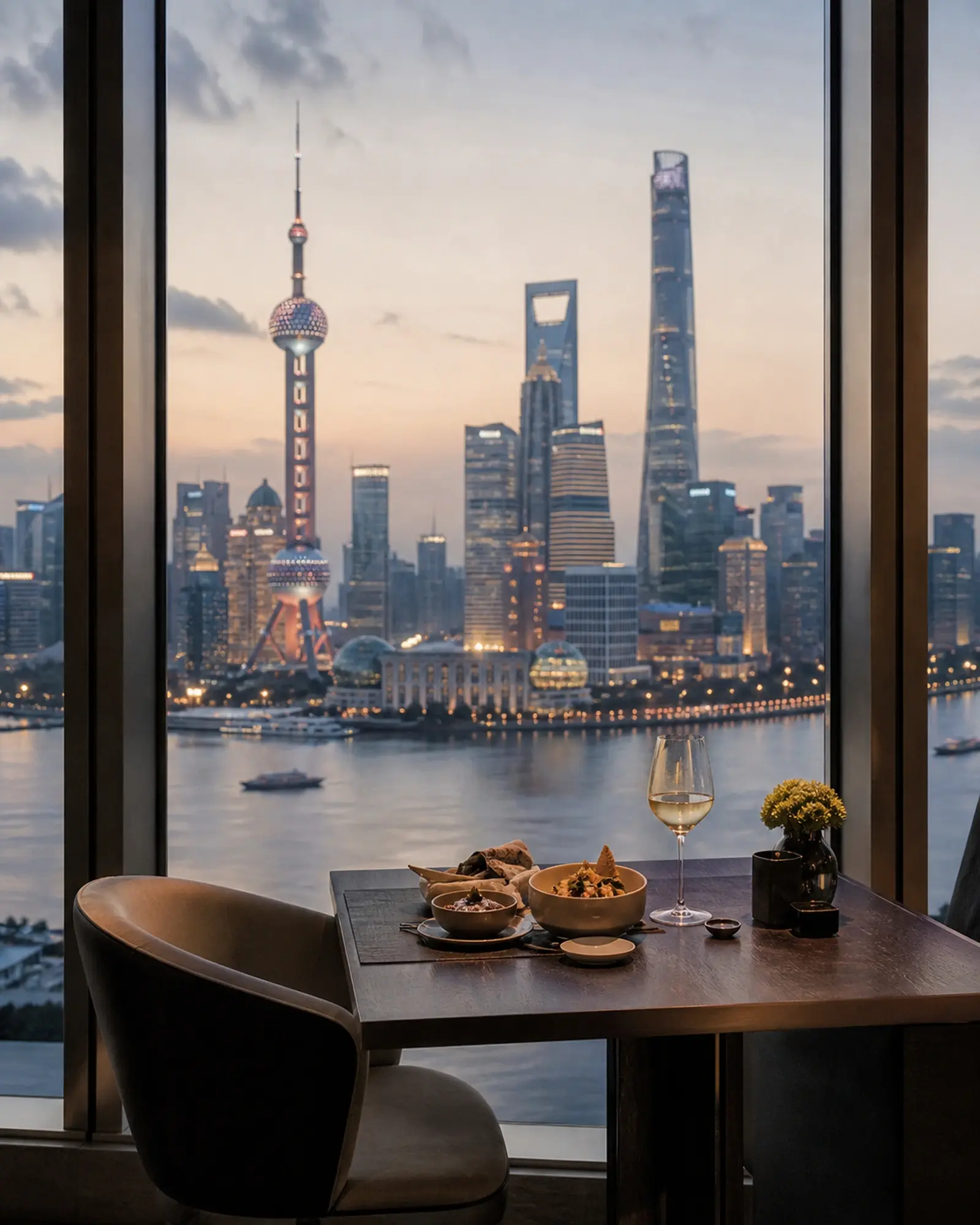
A set dinner table by a window at dusk, the city lights beyondConcept visual

Shanghai · after dark

Dinner is not an afterthought here.

Shanghai eats at every register — soup dumplings folded to order at a counter, hairy crab in its short autumn season, dining rooms that stand comparison with any city on earth. We book the table to fit the evening, not the other way round.

Many travellers land here with meetings first and the city second. The same local team runs the working days and the evenings both — that arrangement has its own page.

The half day out

Canals or gardens — one morning, two answers.

The oldest China within reach of Shanghai is not in Shanghai. It is a short ride west, in the water towns and gardens of the Yangtze delta — close enough to fit before an evening flight.

  • ZhujiajiaoAbout an hour by car

    The nearest of the canal towns: stone bridges, a boat poled under the arches, tea by the water. Honestly — by late morning the coach parties arrive and the lanes fill. We go at opening and are back in the city before they are out of the car park.

  • SuzhouAround half an hour by rail

    A city in its own right, and the deeper commitment: the classical gardens are UNESCO-listed and among the finest things in eastern China, but they deserve most of a day, not a stolen half. When the gardens are the point, we give Suzhou the day and keep Shanghai’s evening.

Sample shape · 3 days

Three days, no wasted hours.

The Bund · French Concession · a water town3 days

Enough time for both Bund appointments, one real walk, and a morning outside the city — without ever feeling like a checklist run at speed.

  • Day 1 — Arrive at Pudong or Hongqiao. A private transfer in, an hour to land properly, then the Bund as the lights come on across the river. Dinner a ten-minute walk away.
  • Day 2 — Yu Garden at opening, before the bazaar around it wakes. The afternoon on foot under the plane trees of the former French Concession. Evening at a table worth the trip in itself.
  • Day 3 — Zhujiajiao’s canals early, or Suzhou’s gardens by rail. Then a transfer timed against your flight — onward into China, or home.

Private guide & driver · handpicked stays · timed entries · airport transfers

This is a shape, not a package — there is no fixed itinerary to buy. It compresses to a long layover and stretches to a week. And if you are transiting, both Shanghai airports are designated ports for the 240-hour visa-free policy — the conditions are laid out plainly on ourvisa-free China page.

Operated by 成都光大国际旅行社 — licensed since 1987Travel licence L-SC-CJ00008See the paperwork →

Good to know

Questions we hear often.

Is Shanghai enough for a first China trip?

For a first taste, yes — it is the easiest landing China offers: direct flights from most of the world, English in the hotels, a centre you can walk. What it cannot do alone is stand in for the whole country; Shanghai is China’s newest great city, not its oldest. For 48–72 hours, or for days added to a business trip, it is exactly right. For a first full journey we would pair it — Suzhou next door at minimum, or a flight inland to somewhere much older.

240-hour visa-free transit — does Shanghai qualify?

Yes. Pudong and Hongqiao airports are both designated ports under the 240-hour (ten-day) visa-free transit policy, which now covers 57 nationalities including the US. You enter through a designated port and hold a confirmed onward ticket to a third country or region within 240 hours — Hong Kong counts. The full conditions are laid out plainly in our visa-free China guide.

Suzhou or Zhujiajiao?

It depends what the morning is for. Zhujiajiao is about an hour’s drive: canals, stone bridges, a boat poled under the arches — compact and photogenic, and busy with coach parties by late morning, which is why we go at opening. Suzhou is around half an hour by high-speed rail and a real city: its classical gardens are UNESCO-listed and genuinely great, but they deserve most of a day. Tight schedule, take Zhujiajiao. Gardens on your list, give Suzhou the day.

Where should we stay?

Three honest answers. On or beside the Bund for a first visit — heritage buildings, the river at the door, both of our Bund appointments a short walk away. In the former French Concession for a second — smaller hotels, plane-tree streets, better coffee, fewer views. In Pudong when the skyline looking back matters, or when the trip is built around flights and meetings. We place you by how your days are shaped, not by a brand list.

Your brief

Tell us your dates and your flights.

Arrival, departure, who’s coming, and what the trip is attached to — three lines is plenty to start.

No payment, no obligation at this stage. Your details stay between us — see our privacy note.

Start the conversation

Stop changing planes here.
Stay two nights instead.

No pitch, no pressure — just a considered first reply from someone who plans China for a living.

Replies in English · Usually within a few hours, always within 24