Xi’an · Terracotta Warriors · Shaanxi

Ride a 600-year-old wall at golden hour.

Two days in China’s old capital, well ordered — the Terracotta Warriors before the coaches, fourteen kilometres of Ming wall by bicycle, and the best eating streets in the north.

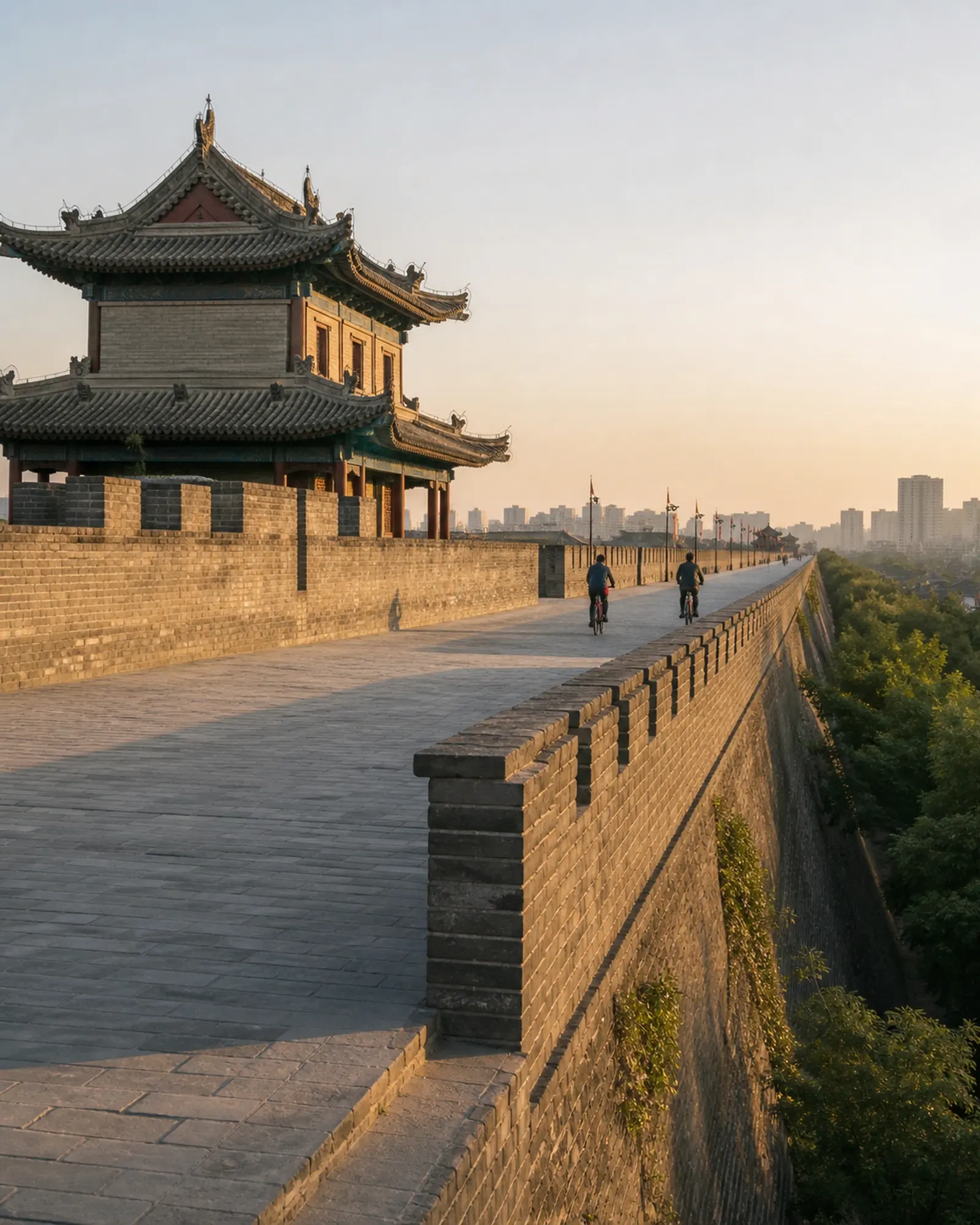
Cyclists on the broad brick walkway of Xi'an's Ming city wall in low evening lightConcept visual

When to go

Autumn is the postcard. Every season has a workaround.

Xi’an works year-round because its two headline acts are weatherproof by design — the pits are under roof, and the wall is at its best in the last light of any clear day. Here is the honest version of each window.

  • September – OctoberThe classic window

    Crisp, mostly clear, and the low autumn sun does its best work on the wall from four o’clock onward. One caveat, and it is a big one: the National Day holiday, 1–7 October, is the busiest travel week of the Chinese year. We plan around it, not through it.

  • March – MaySpring, quietly

    Mild days, the moat willows greening, and crowds well below the autumn line. The occasional dusty wind blows down from the north — a day or two a season, not a pattern — and the Qingming and May Day long weekends spike sharply. Outside those, spring is the connoisseur’s pick.

  • June – AugustHot, honestly

    Afternoons regularly pass 35°C, and July–August brings the domestic school holidays. The schedule bends rather than breaks: Warriors at opening while it is cool, a long lunch and a real siesta, then the wall after five, when the heat lifts and the light turns. Summer here is an argument for planning, not against coming.

  • November – FebruaryWinter, honestly

    Cold, often grey, and the city’s winter air has hazy days — we will not dress that up. But the pits are indoors, the wall is nearly empty, and Xi’an’s food — soups, stews, bread torn into broth — was built for exactly this weather. Around Chinese New Year the wall hangs its lantern festival, at the price of holiday-week crowds.

The Warriors, honestly

Eight thousand soldiers, and most visitors arrive at ten.

The Terracotta Warriors receive tens of thousands of people a day in season, and there is no private door — everyone stands at the same railing. A guided tour of the Warriors earns its keep twice here: once in the timing, once in the telling. This is the playbook.

  • Timed tickets held in advance in your names — entry is real-name, and busy dates sell out
  • Out of the city by seven; the site is about an hour’s drive east
  • Through the doors at opening, straight to the front railing of Pit 1
  • The famous hall first, before the coach waves; Pits 2 and 3 after
  • The bronze chariots kept for mid-morning, while the pits fill behind you
  • Back in town for lunch as the queues peak — noodles, not gift shops

The honest part: much of the site is a working excavation, and Pits 2 and 3 can read as fields of raw earth if no one explains what the earth is hiding. That explanation is the difference between twenty minutes of photographs and a morning you keep thinking about — it is why we treat the guide, not the ticket, as the main event.

The wall at golden hour

Fourteen kilometres of Ming brick, wide as a road.

Xi’an kept its city wall when almost every other Chinese capital pulled theirs down. The whole rectangle survives — moat, gates, watchtowers — and the top is broad enough that cycling the Xi’an city wall is not a stunt but simply the best way to take it in.

  • Bikes rented on top of the wall at the South Gate — singles and tandems
  • The full loop takes about a hundred unhurried minutes; half-loops descend at any gate
  • Start roughly two hours before sunset, so the last stretch rides into the gold
  • The surface is centuries-old brick — gently bumpy, part of the charm, worth knowing about
  • Bell Tower and Drum Tower silhouettes to the inside, the modern city glowing beyond the moat

With children the wall is often the day’s hero — a car-free ride on top of a fortress asks no appreciation of dynasties. Confident young riders do the half-loop; smaller ones share a tandem or walk a stretch between towers. We plan around exactly this on ourfamily journeys.

The eating, and the trade-offs

Eat the Muslim Quarter sideways.

The quarter’s main drag, Beiyuanmen, is a slow river of visitors between souvenir stalls — we will say that plainly. The eating that made the district famous lives one turn away, in the side alleys and along Sajinqiao. The method: arrive hungry, order small, share everything, keep walking. Roujiamo from the griddle, cold liangpi noodles, lamb paomo with the bread torn by your own hands, persimmon cakes on the way out.

  • Giant Wild Goose PagodaThe trade

    Tang-dynasty history at full scale, and the city’s most crowded plaza after dark, when the fountain show pulls thousands. Worth a morning if the Silk Road story pulls you; on a two-day visit it can be skipped without guilt, and we will say which we would choose for your dates.

  • YongxingfangThe trade

    A rebuilt courtyard quarter of Shaanxi eating — pleasant, orderly, and openly engineered for visitors. The biangbiang noodles are real enough. If the Muslim Quarter has already fed you well, this is an option, not an obligation.

  • Shaanxi History MuseumThe trade

    One of China’s great collections, behind one of its scarcest free tickets — entry books out days ahead. We reserve early when the dates allow; when they don’t, the quieter Small Wild Goose Pagoda and its museum make a graceful understudy.

Sample shape · 2–3 days

Two days carry it. A third lets it breathe.

Wall at dusk · Warriors at dawn · the Quarter by night2–3 days

The order matters more than the list. The wall takes the golden hour of your arrival day, the Warriors take the first cool hour of a fresh morning, and the eating takes an evening with nothing scheduled after it.

  • Day 1 — Arrive by high-speed rail — about 4½ hours from Beijing, centre to centre. Drop the bags and be on the wall by five: a golden-hour loop on two wheels, then dumplings near the South Gate.
  • Day 2 — Warriors at gate opening, ahead of the coaches; back in town for a late lunch and a rest. At dusk, the Muslim Quarter’s side alleys, eaten stall by stall.
  • Day 3 — Optional, and recommended: a slow morning — the Small Wild Goose Pagoda, the history museum if tickets came through — then the onward train or flight.

Private guide & driver · handpicked stays · timed-entry tickets · rail seats held

This is a shape, not a package — there is no fixed itinerary to buy. Xi’an most often sits inside a longer journey, and the Beijing–Xi’an high-speed line is the most natural seam in China to build one around.

Operated by 成都光大国际旅行社 — licensed since 1987Travel licence L-SC-CJ00008See the paperwork →

Good to know

Questions we hear often.

How early should we see the Warriors?

At the gate when it opens. The site sits about an hour east of the city, so the day starts at seven — earlier than most people want on holiday, and worth it. The tour coaches arrive in waves from mid-morning; for the first stretch after opening, the railing of Pit 1 is close to yours. We hold timed tickets in your names in advance — entry is real-name and busy dates sell out — and we route the pits so you stay ahead of the tide rather than inside it.

Is one full day enough for Xi'an?

It can be done — Warriors in the morning, wall in the late afternoon — but it runs on rails, and the Muslim Quarter gets squeezed to a snack. Two days is the honest minimum: the Warriors get a calm morning, the wall gets its golden hour, and the eating gets a whole evening. A third day lets the pagodas and museums in, and lets you sleep past six.

Is the Muslim Quarter touristy?

The main drag, yes — Beiyuanmen is a slow-moving crowd between souvenir stalls, and we won’t pretend otherwise. The answer is one turn away: the side alleys, and Sajinqiao to the west, are where the quarter actually eats. Go hungry, order small, keep moving — the crowd thins and the food sharpens with every corner you take off the main street.

Train or flight from Beijing?

Train, almost every time. The high-speed line runs Beijing West to Xi’an North in about four and a half hours, city centre to city centre, with legroom and a view of the north China plain. Flying is two and a quarter hours in the air but loses its lead to airports on both ends. Beijing and Xi’an back-to-back by rail is the most natural pairing in China — see our Beijing pages for the other half.

Your brief

Tell us your dates and your pace.

Dates, who is travelling, and whether the Warriors or the wall matters more — three lines is plenty to start.

No payment, no obligation at this stage. Your details stay between us — see our privacy note.

Start the conversation

The wall has stood six centuries.
Golden hour lasts about twenty minutes.

No pitch, no pressure — just a considered first reply from someone who plans China for a living.

Replies in English · Usually within a few hours, always within 24