Chongqing · Two rivers · Southwest China

The city that shouldn't be possible.

Thirty million people stacked on a mountain between two rivers — a skyline built in storeys, best met for the first time after dark.

The stacked golden lights of Hongyadong rising above the Jialing River at nightConcept visual

When to go

A night city with four honest seasons.

Chongqing performs after dark all year round. What changes with the calendar is the daytime — heat, fog and crowds included.

  • October – NovemberThe clear window

    The best of the year: the summer haze lifts, days settle into the mild teens and twenties, and the river panoramas run long and sharp. One caveat — the National Day holiday, 1–7 October, is the busiest travel week of the Chinese year, and Hongyadong is one of its most photographed stages. We plan around it.

  • March – MaySpring, kindly

    Mild air, blossom on the hillside parks, and the most comfortable months for a city that is climbed as much as walked. Showers pass through — this is a subtropical river valley — but they rarely cost an evening. The first week of May is another national holiday; mid-April is the sweet spot.

  • June – AugustThe furnace, honestly

    Chongqing is one of China's proverbial furnace cities, and the name is earned: high thirties with river humidity, week after week. The honest strategy is to live like the city does — museums, teahouses and the car through the afternoon, then out at dusk, when the breeze comes off the water and the lights make the heat feel almost intentional.

  • December – FebruaryFog season

    This is the fog capital of China, and winter is when it shows. The mist is genuinely part of the city's beauty — neon haloed, towers dissolving mid-storey — but the same fog can white out a daytime lookout entirely. It rarely freezes and the crowds are the year's thinnest. If a clear panoramic photograph is the one thing you came for, we will tell you plainly: this is the gamble window.

The night city

Hongyadong is best seen from across the river.

The frames that fill "Chongqing cyberpunk city" searches are almost never taken inside Hongyadong — they are taken looking at it. Inside, it is a stacked commercial complex moving at shoulder-width in season. The view is the point, and the view belongs to the far bank and the water.

  • The far bank first — Jiangbeizui's embankment, directly opposite, as the eleven storeys of gold light up at dusk
  • Qiansimen Bridge's pedestrian deck for the higher angle, a few minutes' walk along the shore
  • A short pass-through of Hongyadong itself if you want it — early evening, before the lights pull the crowds in
  • A two-rivers night cruise from Chaotianmen, timed for the lights at full — the whole skyline at drifting speed
  • Dinner after the lights, not instead of them — the display ends late in the evening, and we sequence around it
  • A fog check on the day — when the river mist sits low, we move the viewpoint down, not give it up
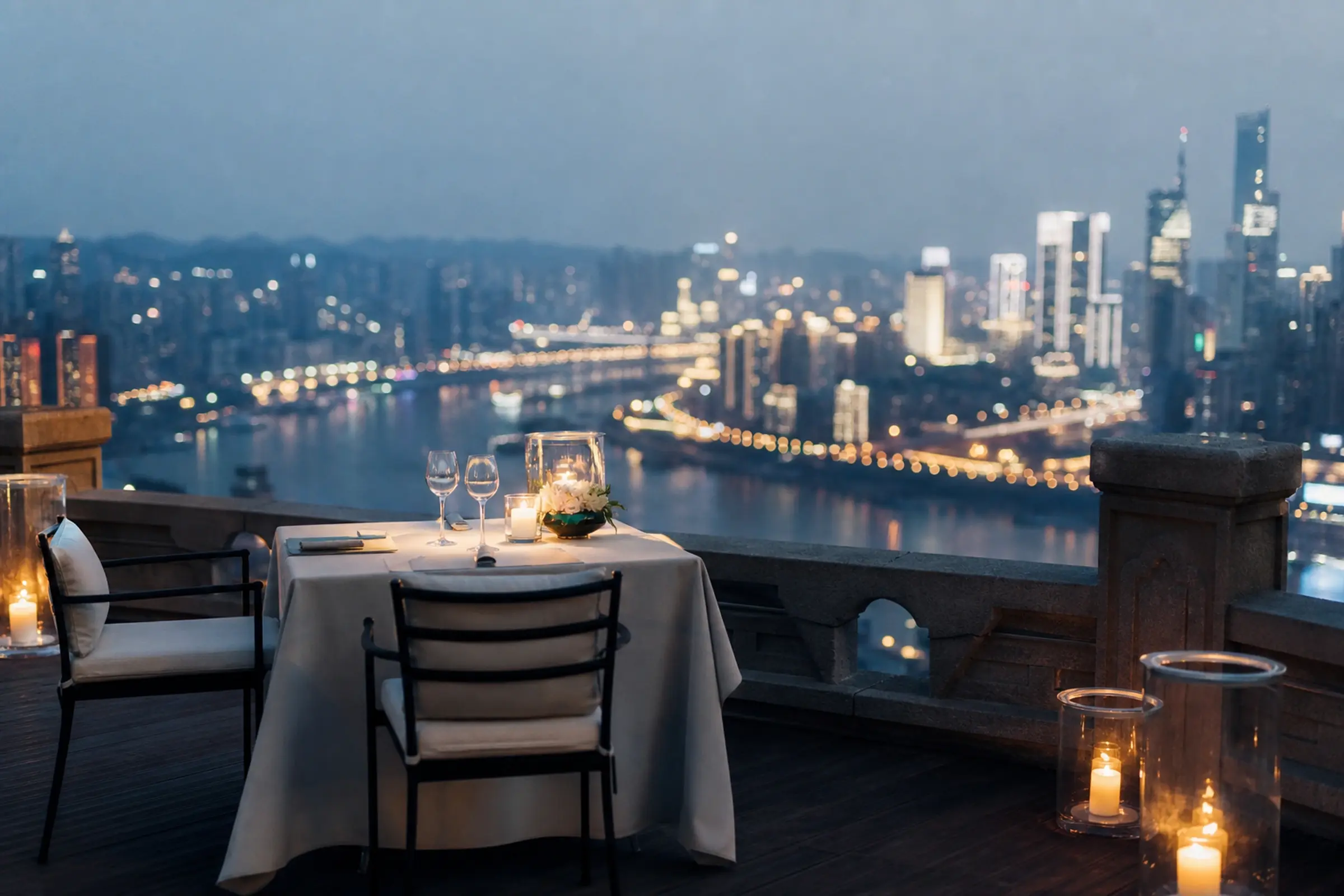
A couple at a quiet rooftop terrace table above the lit rivers of Chongqing at nightConcept visual

Chongqing · a table above the rivers

The terrace, after the cruise.

The crowds watch the lights from the embankments. A booked rooftop table watches them from above — the two rivers meeting in the dark, the ferries drawing lines of light between the banks. It is the reason so many of our honeymoon journeys open here: no city in China begins a trip with more drama for less effort.
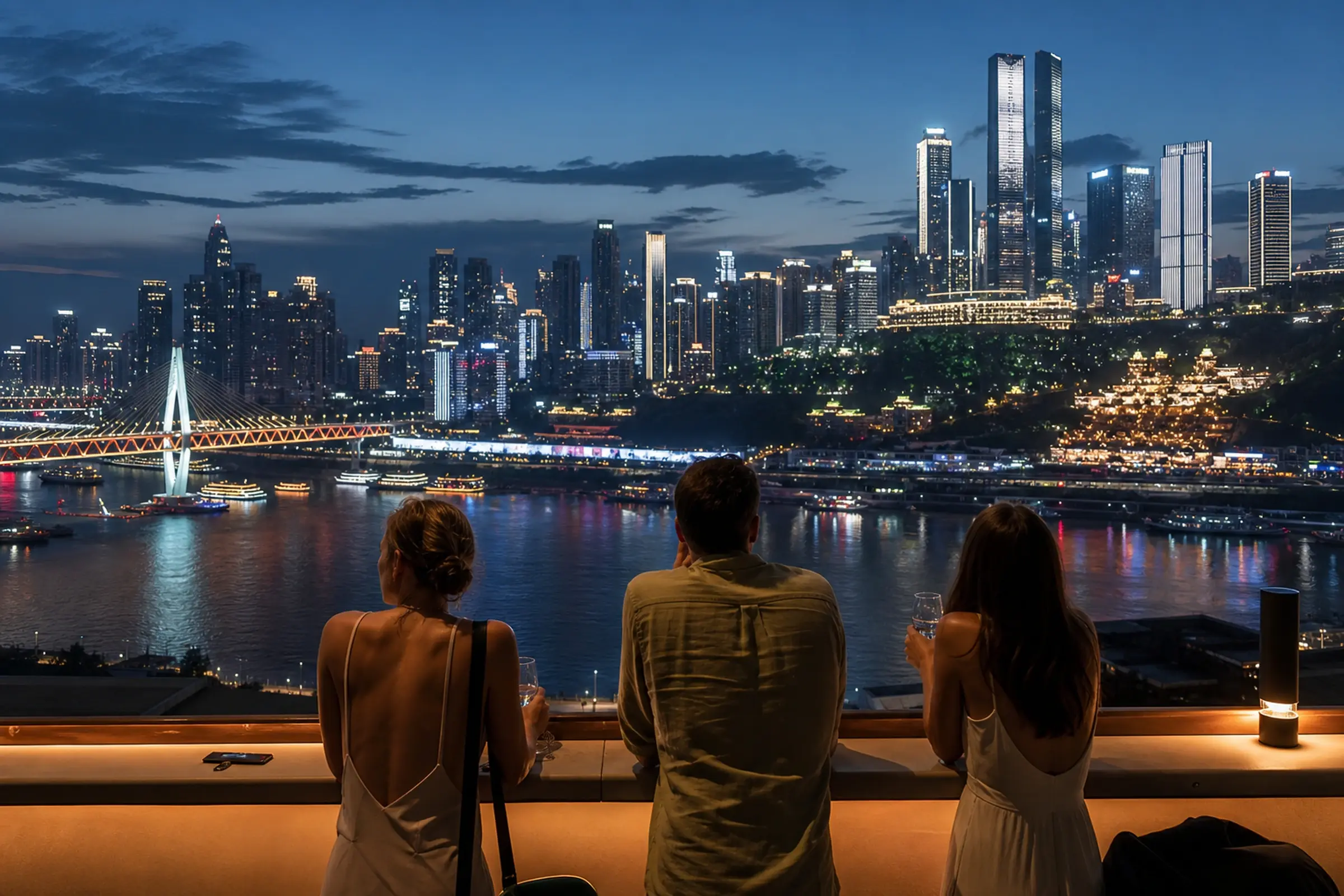
Friends looking out over the stacked night skyline of Chongqing from a rooftopConcept visual

Chongqing · the stacked skyline

A skyline with no ground floor.

From a rooftop, the trick of the city reveals itself: towers planted at different heights on the same mountain, so the skyline has no single horizon. Streets pass over other streets; a door on level one opens onto somebody else's level twelve. Photographs flatten it. Standing in it is the only way it makes sense.

The 8D city

Where the map needs a third dimension.

Chinese internet users call Chongqing the 8D city, because a flat map is nearly useless here. Four places make the point best — with the honest note on what each one actually asks of you.

  • LizibaThe train through the building

    A monorail line passing through the eighth floor of a residential block — the building was designed around it, and the flats barely hear it. Honestly: the moment itself lasts seconds, and the queue for the perfect camera angle can last longer. We fold it into a morning along the Jialing rather than making a pilgrimage of it.

  • Shancheng trailsThe stair city on foot

    The old stepped lanes — the Third Trail above the Yangtze is the best of them — where boardwalks hang off the cliff face and the city's older life carries on above the towers. This is the walk that explains Chongqing. It is stairs by definition; we pace it downhill and keep the car waiting at the bottom.

  • Kuixing LouThe ground floor on the 22nd

    A public plaza that meets the street on one side and sits twenty-two storeys above another street on the other. Nothing to queue for, nothing to buy — just the city's geometry, plainly stated. Five unhurried minutes here do more than any explanation.

  • Yangtze cablewayThe commuter ride turned icon

    A 1980s commuter cable car swinging out over the Yangtze, now far more famous than practical — in season the queue outlasts the ride several times over. Ridden one-way toward the south bank at dusk it earns its place; on a tight day, the night cruise shows you more of the same river for none of the standing.

Hotpot, honestly

The city that invented it does not hold back.

Hotpot was born on these docks, and Chongqing still takes it as a point of civic pride — beef-tallow broth, a tide of dried chilli, and Sichuan pepper that numbs before the heat lands. It is one of the great eating experiences in China, and it deserves a plan.

  • The honest scale: what Chongqing calls mild, most visitors call serious — order one level below instinct
  • The numbing is the surprise, not the heat — Sichuan pepper tingles first, and it fades as quickly as it comes
  • A yuanyang split pot puts a gentle broth beside the red one — some locals will tease; order it anyway
  • The sesame-oil-and-garlic dip is the brake pedal every table in the city uses
  • An old-style hotpot house away from the tourist strip, with a guide who orders — the menu assumes you grew up here
  • For anyone who wants none of it, Chongqing's small noodles and river fish make an excellent evening too

Sample shape · 2–3 days

Arrive by night. Stay for the stairs.

The night rivers · The stair city · Onward2–3 days

Chongqing frontloads its drama, which makes it a natural opening chapter — or a short, vivid hinge between longer ones. The order matters: the lights first, the geometry the next day.

  • Day 1 — Arrive. At dusk, the far bank of the Jialing as Hongyadong lights up, then the two-rivers cruise from Chaotianmen. A rooftop table above the confluence to end the night.
  • Day 2 — The Shancheng Third Trail walked downhill in the morning, Liziba's train through the building on the way, the city's stacked plazas by car. Hotpot at an old-style house to close — split pot on the table, no apologies.
  • Day 3 — Onward: the high-speed train to Chengdu in under two hours, a day out to Wulong's karst bridges, or the airport. Chongqing hands over cleanly.

Private guide & driver · night-cruise tickets held · handpicked stays · station & airport transfers

This is a shape, not a package — there is no fixed itinerary to buy. Two days can become three, and the city pairs naturally withChengdu and Sichuan — one rail line, two entirely different tempos.

Operated by 成都光大国际旅行社 — licensed since 1987Travel licence L-SC-CJ00008See the paperwork →

Good to know

Questions we hear often.

Is one night enough for Chongqing?

One night gives you the postcard — the far-bank view of Hongyadong at lighting-up and a two-rivers cruise make a complete, genuinely great evening. But the postcard is only half the city. The stair-street neighbourhoods, the train through the building and a proper hotpot evening all live in the daylight hours around it, so two nights is our honest recommendation. Travellers passing through to a Yangtze cruise or onward by rail can absolutely make one night count; we simply shape it so the evening lands exactly right.

Where is the best Hongyadong view?

Not inside it. Hongyadong is a stacked commercial complex, and in season its walkways move at shoulder-width — worth a short pass-through, not an evening. The famous photograph is taken from across the Jialing River: the Jiangbeizui embankment directly opposite, or the pedestrian deck of Qiansimen Bridge for a higher angle. We put you on the far bank as the lights come up at dusk, then out on the water so the whole cliff of gold slides past at cruise speed. The lights go down late in the evening, so dinner comes after, not instead.

How spicy is the hotpot, really?

Genuinely fierce — this is the city that invented it, and what a Chongqing kitchen calls mild would be labelled a warning elsewhere. The surprise is not the heat but the numbing: Sichuan pepper tingles before the chilli arrives. The honest fixes work well. A yuanyang split pot puts a mild broth beside the red one; the sesame-oil-and-garlic dip is the brake everyone at the table uses; and ordering one level down from your instinct costs no pride at all. Some locals will tease you about the split pot. Order it anyway.

Chongqing or Chengdu — which first?

The high-speed train links them in well under two hours, so the order is a choice of rhythm rather than logistics. Our usual advice is Chongqing first: arrive into the drama — the stacked skyline, the night rivers, the fiercest food — then let Chengdu and Sichuan slow the pulse with pandas, teahouses and plains that stay flat underfoot. Run the other way, and Chongqing makes a strong final chord instead of an opening one. Both work; tell us how your trip should end and we will point the trains accordingly.

Your brief

Tell us your dates and your appetite.

Dates, who's coming, and how everyone feels about chilli and stairs — three lines is plenty to start.

No payment, no obligation at this stage. Your details stay between us — see our privacy note.

Start the conversation

Arrive after dark.
Chongqing does the rest.

No pitch, no pressure — just a considered first reply from someone who plans China for a living.

Replies in English · Usually within a few hours, always within 24